Ethical Underwear: The Best Sustainable Brands and What to Check
The category where the material sits against skin all day, and where the
claims are unusually easy to verify.
Ethical underwear is the most checkable corner of the wardrobe. A pair of briefs is
two or three materials and a few seams, so a composition label tells you nearly everything; the
garment is bought repeatedly, so a bad decision repeats; and because it is worn against skin,
chemical residue and dye standards matter more here than almost anywhere else.
Almost every claim in this category rests on one of four fibre families, and each has a genuine
drawback. Knowing the drawback is what separates a decision from a purchase.
The four fibre families
Fibre
The case for it
The catch
Organic cotton
Grown without synthetic pesticides; GOTS certification covers fibre content and processing; washes and mends well.
Thirsty crop even when organic, and elastane is still added at the waistband.
Bamboo viscose
Fast-growing plant, very soft handle, good moisture behaviour.
"Bamboo" reaches fabric through a chemical pulping process; closed-loop systems exist but are not universal.
TENCEL / lyocell
Wood pulp processed in a largely closed-loop solvent system, with a documented supply chain.
Branded fibre, so the price floor is higher; still a processed cellulose.
Recycled synthetics
Needed for stretch and support; keeps existing plastic in use.
Sheds microfibres in the wash and cannot be composted at end of life.
Note what no fibre solves: elastane. Nearly all underwear contains a few per cent of it, and it is
the reason a pair of briefs is difficult to recycle regardless of the cotton it started as. Any
label claiming a fully compostable stretch garment deserves a direct question.
Labels
The best ethical underwear brands to know
02
Organic Basics — Copenhagen, organic cotton
Underwear, activewear and basics designed in Copenhagen, described by the label as made with a
focus on lower-impact production and materials including organic cotton. The range is deliberately
narrow and repeats season to season, which is the useful part.
Best for: replacing a whole drawer with one composition you can check.
Ask: which fibre is in the specific style — the range spans several.
organicbasics.com
03
Pact — organic cotton, Fair Trade factories
A cotton-first label that states organic cotton, Fair Trade certified factories and carbon
neutral shipping as its position. Of the five here it is the most explicit about labour
certification rather than fibre alone.
Best for: buyers who weight factory conditions above material novelty.
Ask: which factories carry the certification, since it is issued per site.
wearpact.com
04
Boody — bamboo viscose basics
Bamboo-based underwear and socks, which the label describes as up to 95% organic bamboo. The
handle is the selling point and it is a real one; the pulping question above applies here more
than to any other entry.
Best for: sensitive skin and hot climates.
Ask: whether the viscose process is closed-loop.
boody.eu
05
Underprotection — Danish lingerie and loungewear
A Copenhagen label covering lingerie, loungewear, swimwear and hosiery, which puts
sustainability and recycled materials at the centre of how it describes itself. The widest style
range of the five.
Best for: anyone who wants lingerie rather than basics.
Underwear and sleepwear made from natural and recycled materials, with the label's own emphasis
on getting the fit right. That order of priorities is defensible: an ill-fitting bra is discarded
long before it wears out, whatever it is made of.
Best for: bras, where fit dominates every other variable.
Ask: for the composition of the band and straps specifically.
nudea.com
Four checks before buying ethical underwear
Read the composition, not the adjective. A percentage breakdown beats every word on the page.
Look for a certification that covers what you care about. GOTS for organic content and processing, OEKO-TEX for chemical residue, Fair Wear or Fairtrade for labour.
Check the range repeats. A style still sold next year can be replaced piece by piece instead of a drawer at a time.
Buy your actual size. The most sustainable underwear is the pair that gets worn out rather than the pair that sits folded.
Why this category is the easiest place to start
A coat involves a dozen materials, a lining, interfacing and hardware; a pair of briefs involves
three. That makes ethical underwear a good first test of whether a label can answer a plain
question about its own product, and the answer tends to predict how the rest of its range is run.
The ethical underwear brands listed above each answered it in their own published words;
sustainable underwear labels that could not are simply absent.
It is also the category where the sustainable underwear argument is least about fashion. Nobody
replaces basics for a trend, so the whole discussion reduces to fibre, factory, fit and how long
the elastic holds — four things a label either publishes or does not. The best ethical underwear
brands publish all four; the rest publish a word.
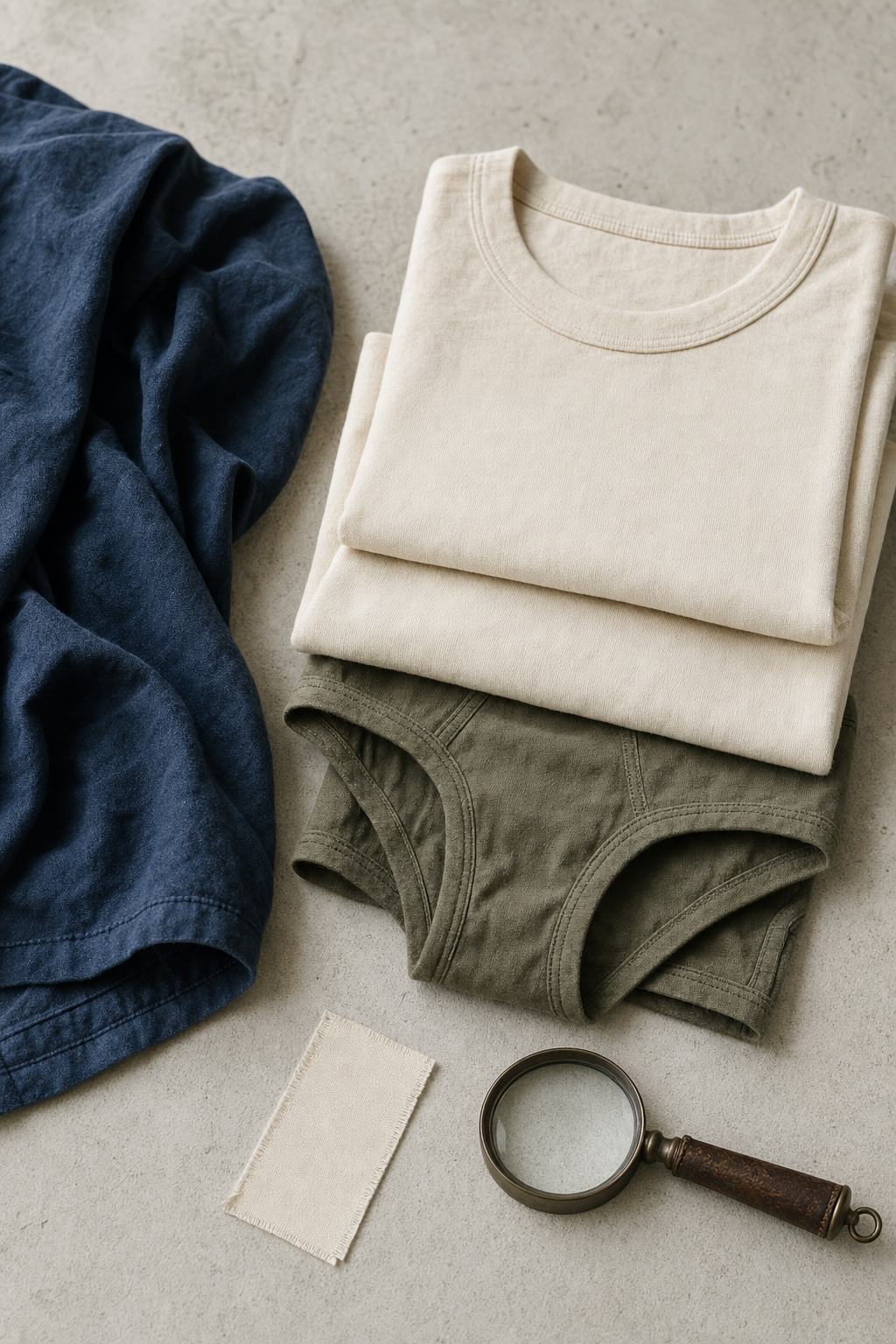
The composition label is the whole argument: a fibre and a percentage, per garment.
Questions
Common questions
What is the most sustainable underwear material?
There is no single answer. Organic cotton mends and washes well but is a thirsty crop. Bamboo viscose is soft but reaches fabric through chemical pulping. TENCEL lyocell uses a largely closed-loop process at a higher price. Recycled synthetics deliver stretch but shed microfibres and cannot be composted.
Is bamboo underwear actually eco-friendly?
The plant grows fast with little input, which is the genuine part. Turning it into fabric normally means a chemical viscose process, and closed-loop systems exist but are not universal, so the honest question to a label is which process it uses.
Why does almost all underwear contain elastane?
Because the waistband and leg openings need recovery. A few per cent of elastane is what stops a pair of briefs going baggy, and it is also the reason the garment is difficult to recycle whatever the main fibre is.
Which certifications matter for underwear?
GOTS for organic fibre content and processing, OEKO-TEX for chemical residue (relevant because the garment sits against skin all day), and Fair Wear or Fairtrade for labour conditions in the factories.
How many pairs do you actually need?
Fewer than most drawers hold. Buying one composition you can verify, in a style that repeats next season, makes replacement piece by piece possible instead of a drawer at a time.