What is slow fashion?
Where the term came from, what separates it from a marketing line, and how to recognise a label that actually works that way.
The guide
Written guides to buying, repairing and keeping clothes, and to the small labels doing the work rather than announcing it.
Most lists of sustainable fashion brands are assembled from press releases. This one starts from the garment: what it is made of, who assembled it, how long it is meant to last and what happens to it afterwards. Where a claim cannot be checked against something a label publishes itself, it is left out.
Guides
Where the term came from, what separates it from a marketing line, and how to recognise a label that actually works that way.
Five labels working with deadstock denim, reworked second-hand clothing, hemp footwear and zero-waste pattern cutting.
The category where material and factory matter most, and where certification claims are easiest to check.
The difference is rarely the fabric alone. Organic cotton in a garment assembled under conditions nobody will describe is not an improvement on conventional cotton; a recycled polyester jacket that falls apart in two winters has simply moved the problem downstream. The best sustainable fashion brands tend to be legible: they name the mill or the factory, they publish what a material actually is, they sell a repair service or spare buttons, and they keep styles in production long enough that a garment can be replaced rather than mourned.
Legibility is also the only quality a reader can verify without visiting a factory. Every label named across this site is described using what that label states publicly about its own materials and production. Where a label makes no such statement, that silence is the finding — and it is the reason a number of otherwise appealing ethical clothing brands are absent.
Certification helps, with limits. GOTS covers organic fibre content and processing; Fairtrade and Fair Wear address labour standards; B Corp assesses a whole company rather than a product. None of them promises the garment will suit you or survive a decade of washing, which is why the guides here spend as much time on construction and care as on credentials.
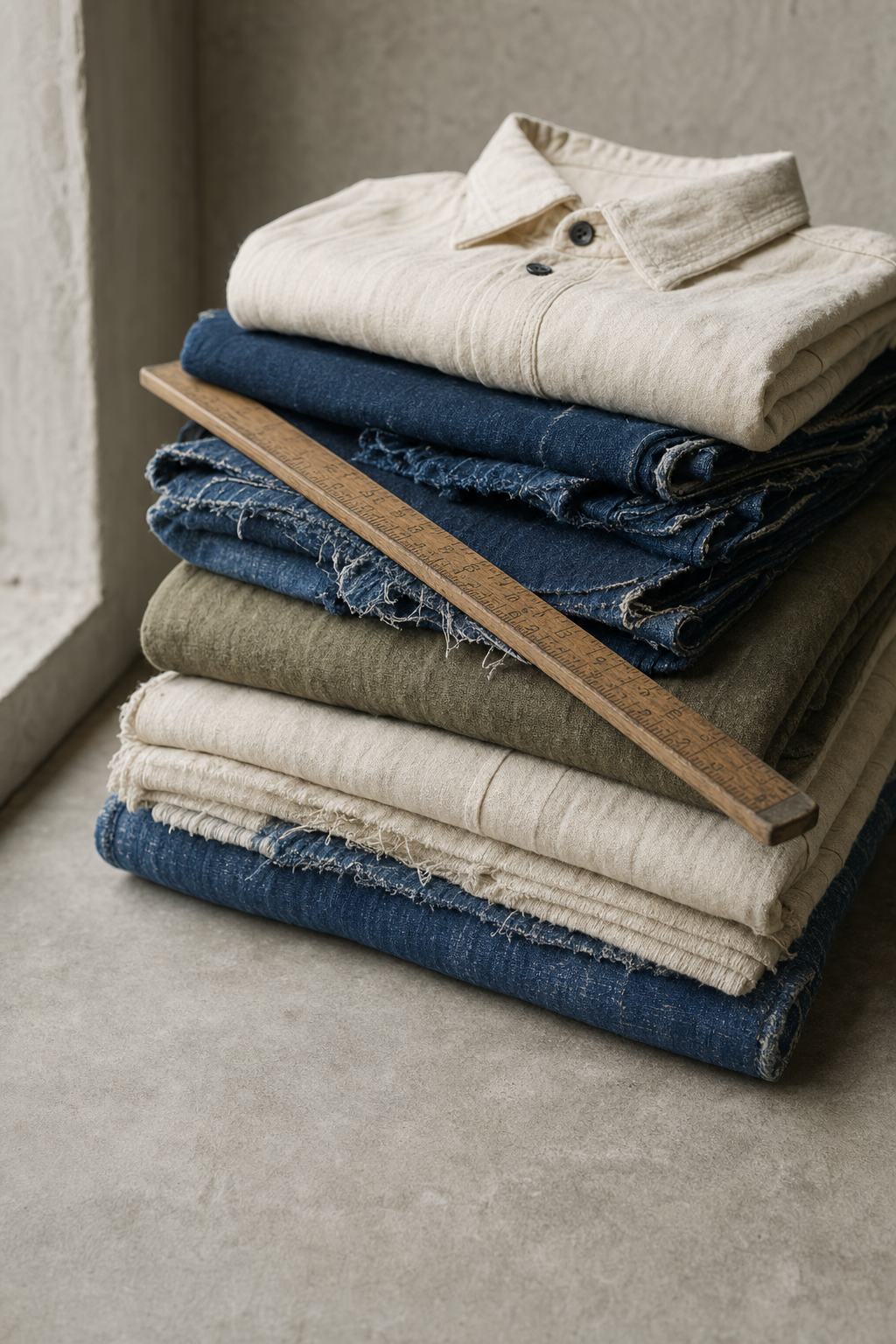
A conscious capsule inside a company producing fifty collections a year is a marketing division. The independent labels covered here are small enough that a design decision and a production decision are made by the same people, which is what makes traceability plausible in the first place.
Small also means fragile. Labels close, sometimes between one season and the next, and the shops listed in the vintage directory were each re-checked at their own address before publication rather than copied forward from an older list. Independent labels appear and disappear faster than any directory can pretend otherwise, so these pages say plainly when something could not be confirmed. That is the best a written guide can honestly offer.
Each guide answers one question and stops. The slow fashion guide is the vocabulary: read it first if terms like deadstock, circularity and micro-season are doing more work than meaning in the shops you browse. The menswear and underwear guides are label-by-label, with what each one states about its materials and where it is based. The Amsterdam directory is practical: names, neighbourhoods and links, no opening hours, because those change faster than any page can track.
The pages exist to make a small number of ethical clothing brands and shops easier to compare, and to be honest about how thin the public evidence sometimes is. If a sustainable fashion brands list is what brought you here, the sections above are the shortest route through it.
| Page | What it covers |
|---|---|
| Slow fashion | The vocabulary, where the term came from, and five checks for a label |
| Vintage shops | Nineteen secondhand shops in Amsterdam, Rotterdam, Berlin and London |
| Clothing repair | Seven repair and alteration services, and the four repairs worth learning |
| Fashion waste | Which statistics trace to a real study, and who is cutting waste |
| Vegan footwear | Apple, grape, cactus and mycelium leather, and the binder in all of them |
| Vegan clothing | Wool, silk, down and trim — where the claim gets difficult |
| Sustainable dresses | Fibre by fibre, and how to solve the one-occasion dress |
| Everyday swaps | Bedding, socks, soap and swabs — and the swaps not worth making |
| Menswear | Five labels working with deadstock, reworked cloth and hemp |
| Underwear | Five labels and four fibres compared |
| T-shirts | Weight, yarn, seams and ink — the four numbers that matter |
| Jeans | Why finishing rather than cotton is the damaging part of denim |
| Jackets and coats | Insulation, shells, coatings, linings and the zip that ends a coat |
| Accessories | Jewellery, scarves, socks and bags, and four questions for any of them |
| Olive green shirt | One garment in detail: fabric, fit, care and what to check |
| Natural massage oil | Carrier oils, what to avoid, and what certification covers |
| VIRÓN | Plant-based footwear from Paris, made in Portugal |
| Stem | Zero-waste garments woven to shape on the loom |
| Studio Mend | Visible mending as the point rather than the apology |
| Archivist Studio | Shirts cut from retired luxury hotel linen |
| Can Pep Rey | Ibiza, 2014, and an unusually public production map |
| Solitude Studios | Copenhagen, undyed and hand-dyed natural fibre, deadstock |
| Mia Larsson | Stockholm jewellery in restaurant shells and recycled silver |
| Helen Kelen | Garments built from the smallest factory offcuts, in Croatia |
Questions
There is no legal definition, which is why this site uses a checkable one: the label publishes what its garments are made of, names where they are produced, anticipates repair, and keeps styles in production long enough that a piece can be replaced rather than mourned.
A brand that meets none of those and simply describes itself as conscious has made a claim nobody can test.
No. GOTS covers organic fibre content and processing, Fairtrade and Fair Wear address labour standards, and OEKO-TEX addresses chemical residue. Each covers one slice of the problem.
A certification is useful evidence and a poor summary. Small labels sometimes hold none while doing the work, and a badge on a landing page says nothing about the garment you are holding.
Because the requirement is a published statement from the label itself, in its own words, on its own site. Labels that make unquantified claims, or whose only detail is a certification badge, are left out rather than described vaguely.
For most garment types, yes: the item already exists, so nothing new had to be produced. The exception is fit and use: a secondhand garment that does not fit gets worn twice, which undoes the advantage.
That is why the vintage directory and the label guides sit alongside each other here.
With the vocabulary, if terms like deadstock, circularity and micro-season are doing more work than meaning in the shops you browse; the slow fashion guide covers those in order.
If a specific purchase is the reason you are here, the label guides are organised by category rather than by brand name.